
Annihilation radiation is produced when a positron, the antimatter counterpart of an electron, encounters an electron. The two particles annihilate, converting their mass into energy. This process typically produces two gamma-ray photons, each with an energy of 511 keV, emitted in nearly opposite directions. The resulting 511 keV peak is a characteristic feature of gamma spectra involving positron-emitting radionuclides.

Annihilation radiation plays a central role in positron emission tomography (PET), a medical imaging technique used to visualize metabolic and biological processes inside the body. PET scanners detect pairs of 511 keV photons to reconstruct the distribution of positron-emitting radiopharmaceuticals. The same radiation is also studied in nuclear physics, particle physics, and gamma-ray astronomy.

The 511 keV gamma line can be observed near radioactive sources that emit positrons, such as F-18, Na-22, and Ga-68. Of these, Na-22 (half-life 2.6 years) is the one commonly used as a laboratory check source; F-18 and Ga-68 live only minutes to hours. A person who has recently had a PET scan (typically with F-18, half-life about 110 minutes) emits 511 keV radiation for several hours afterwards — a common cause of alarms on personal radiation detectors. The line also appears wherever gamma rays with energies above 1022 keV produce electron–positron pairs: for example, spectra of Th-232 sources (gas lantern mantles, thoriated welding electrodes) show a 511 keV peak created by the 2614 keV gamma line of Tl-208. A weak 511 keV peak is also present in the natural background due to cosmic-ray interactions, so its presence alone does not necessarily indicate a positron-emitting source. Annihilation radiation also occurs in certain astrophysical processes and can be detected in laboratory experiments, medical imaging facilities, and radioactive-source measurements.
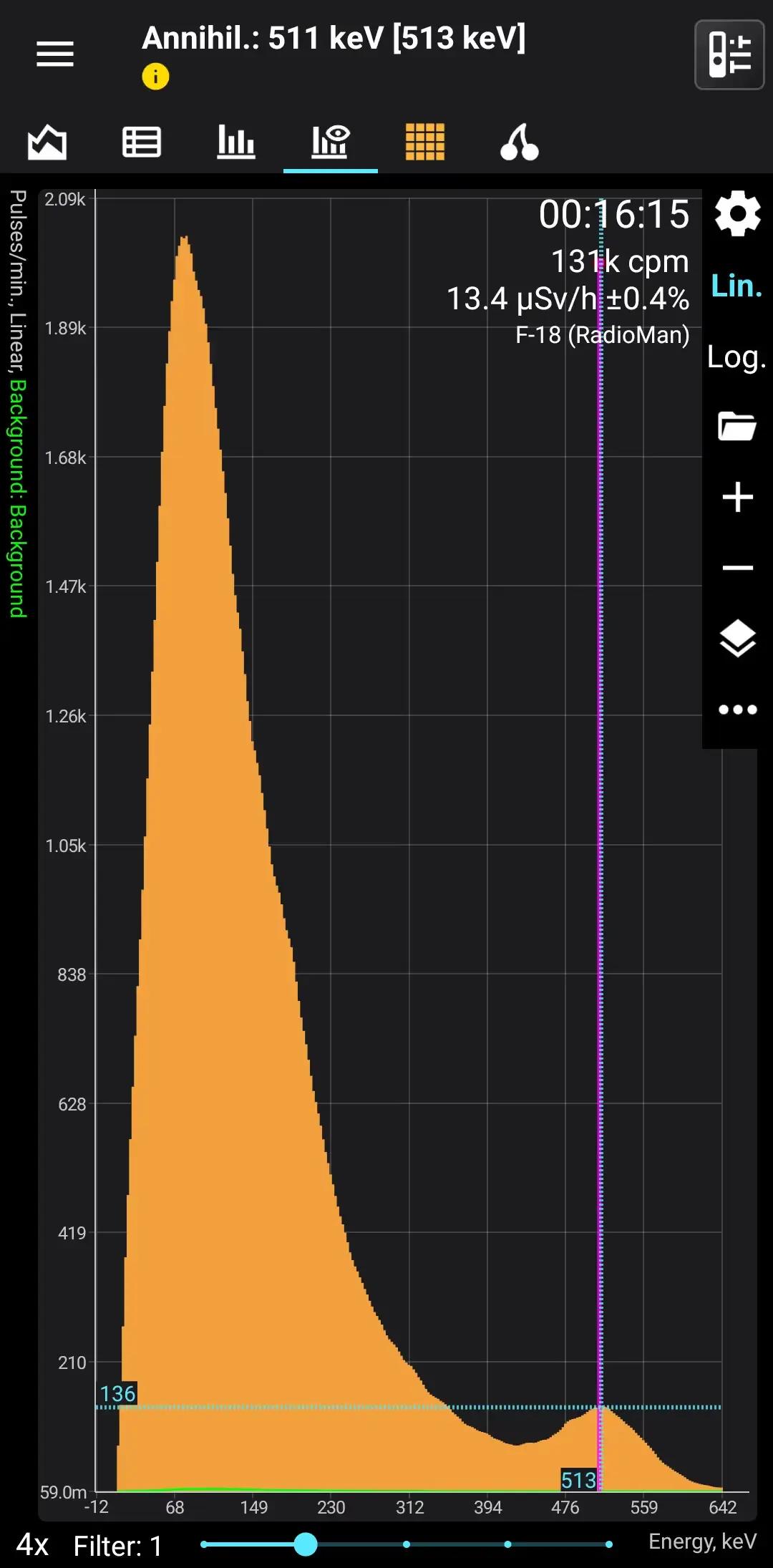
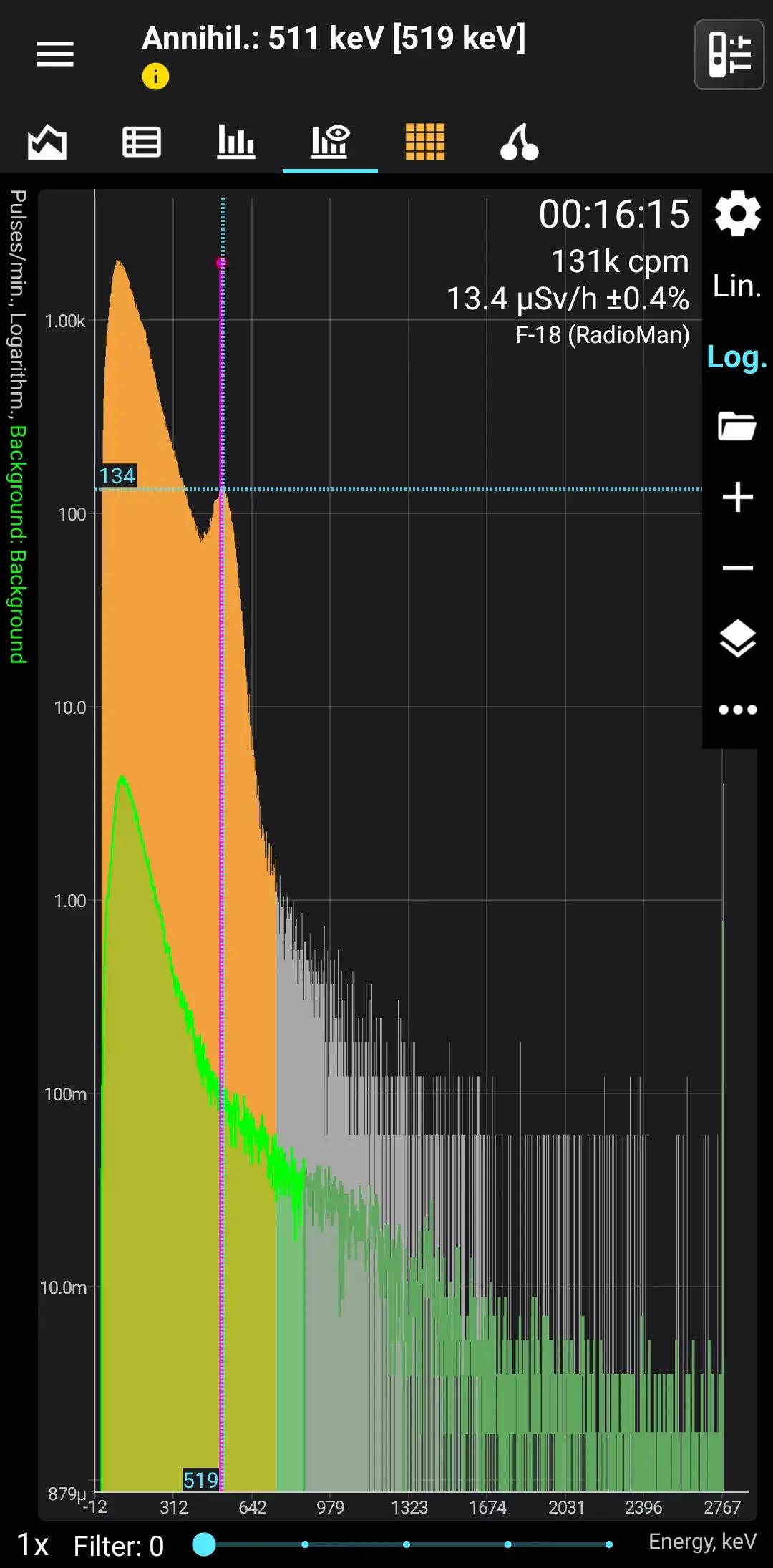
The electron-positron annihilation line
Main emission lines: 511 keV