
Manganese-54 (Mn-54) is a radioactive isotope of manganese with a half-life of approximately 312 days. It decays by electron capture to stable chromium-54, emitting a single gamma ray at 834.8 keV in practically every decay; it has no significant beta emission. Mn-54 is produced artificially, mainly by fast-neutron irradiation of iron-54 (the Fe-54(n,p)Mn-54 reaction), which makes it a typical activation product of steel in nuclear reactors; it can also be made in cyclotrons, for example by proton irradiation of chromium-54. Due to its radioactive properties and clean gamma emission, it is used in various scientific and industrial applications.

Mn-54 is primarily used as a tracer in environmental and biological research. Its gamma emissions allow scientists to study the behavior and distribution of manganese in ecosystems, soil, and water systems. It is also used in corrosion studies to analyze the wear and degradation of materials in industrial processes. Additionally, Mn-54 serves as a calibration source for gamma-ray detection instruments in laboratories and nuclear facilities.

Mn-54 is not naturally occurring on Earth and is found as an activation product in reactors and in environments exposed to significant neutron flux: it appears in the coolant and corrosion deposits of nuclear power plants, where it is formed from the iron of steel components, and in their effluents. It was present in the early fallout from the Chernobyl accident. Trace amounts of cosmogenic Mn-54 exist in iron meteorites, where it is produced by cosmic rays from iron.
For Radiacode users Mn-54 is mostly met as a sealed calibration source. Its spectrum is a lone peak at 835 keV with no companion lines and no beta component; the chromium X-rays at 5.4 keV are below the detector threshold. It should not be confused with Co-58 (811 keV) or Cs-137 (662 keV).
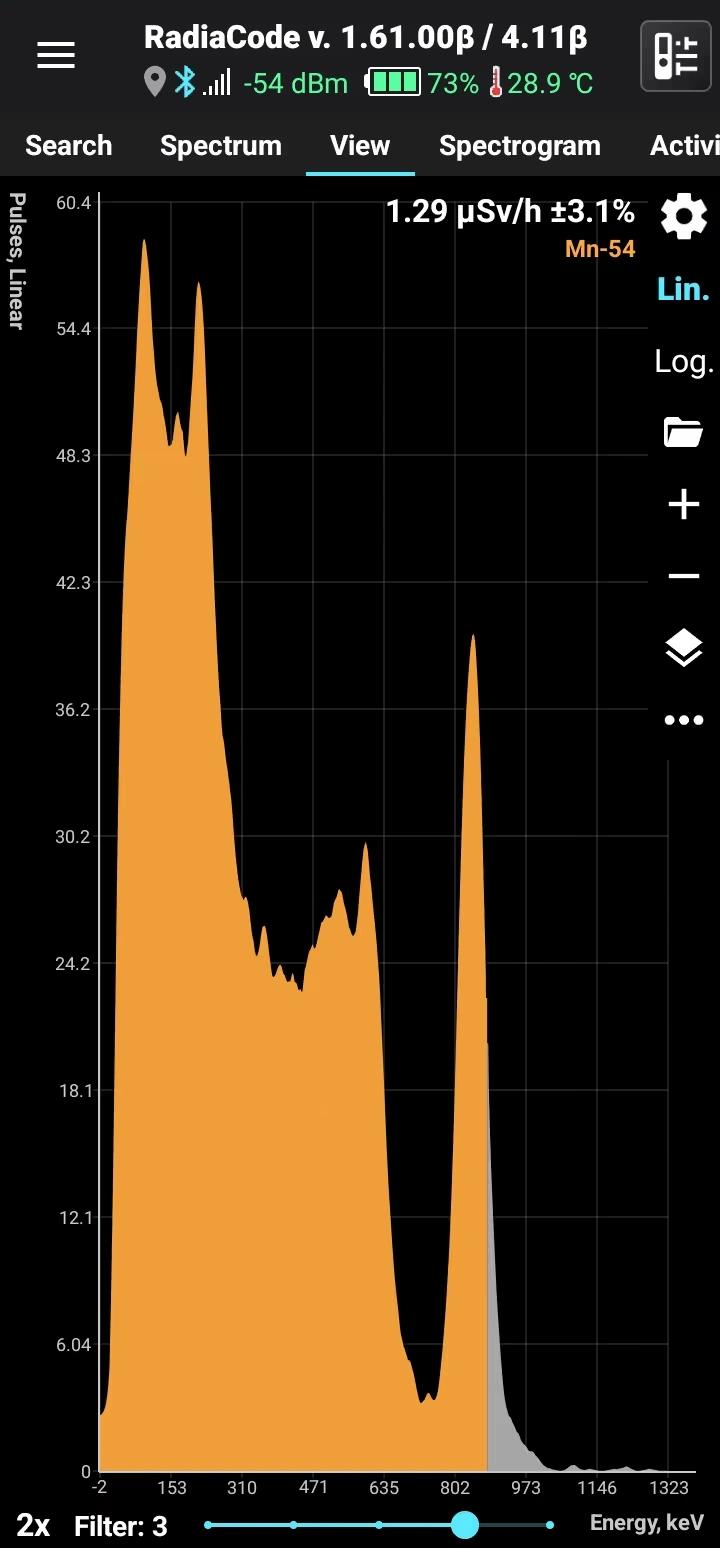
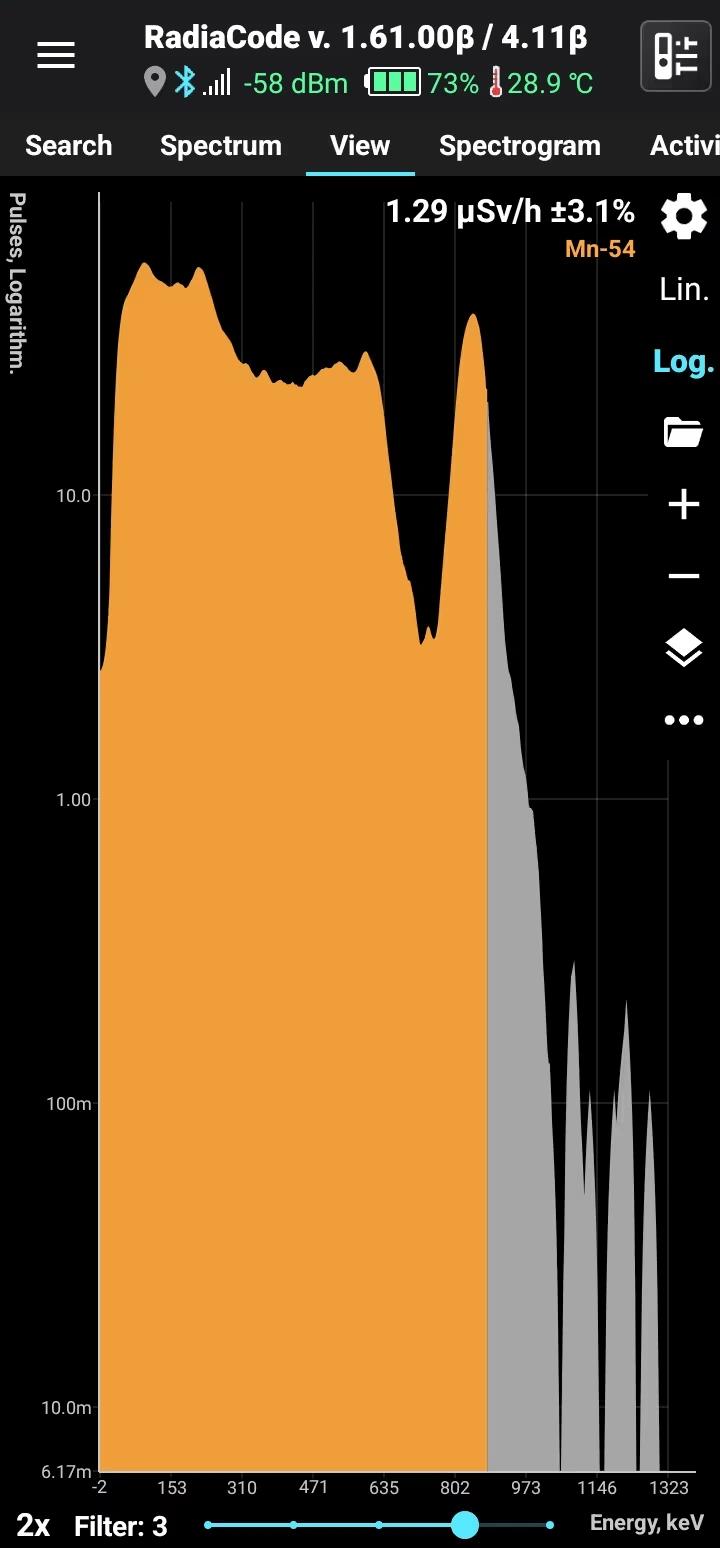
Mn-54
Manganese-54
Half-life: 312.2 days Main emission lines: 835 keV
Decay mode ec
Gamma
| Energy, keV | Intensity, % |
| 834.848 | 99.976 |
X-rays
| Energy, keV | Intensity, % |
| 5.415 | 15.0 |
| 5.406 | 7.65 |
| 5.946 - 5.987 | 3.05 |
| 0.500 - 0.694 | 0.65 |