
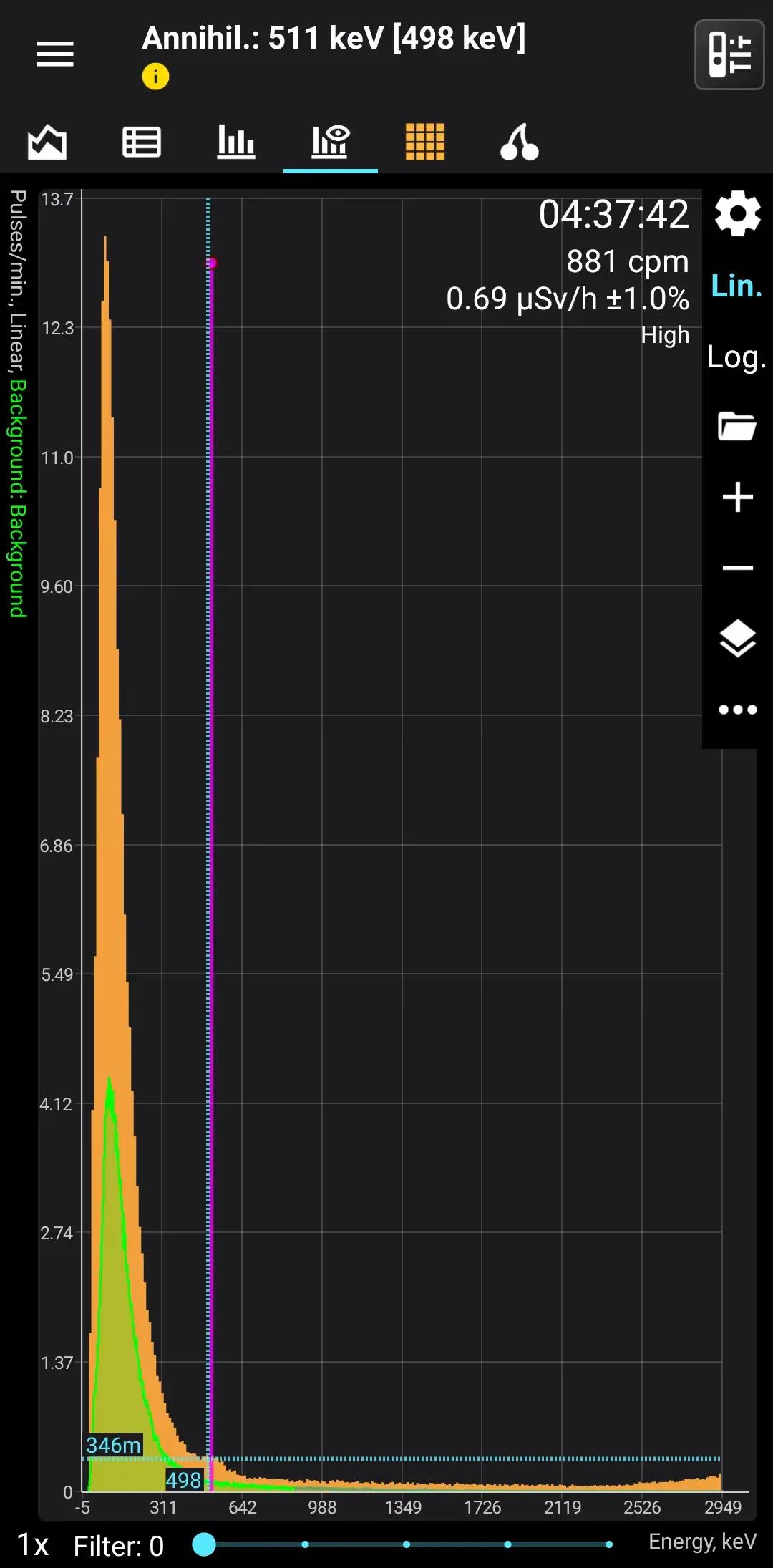
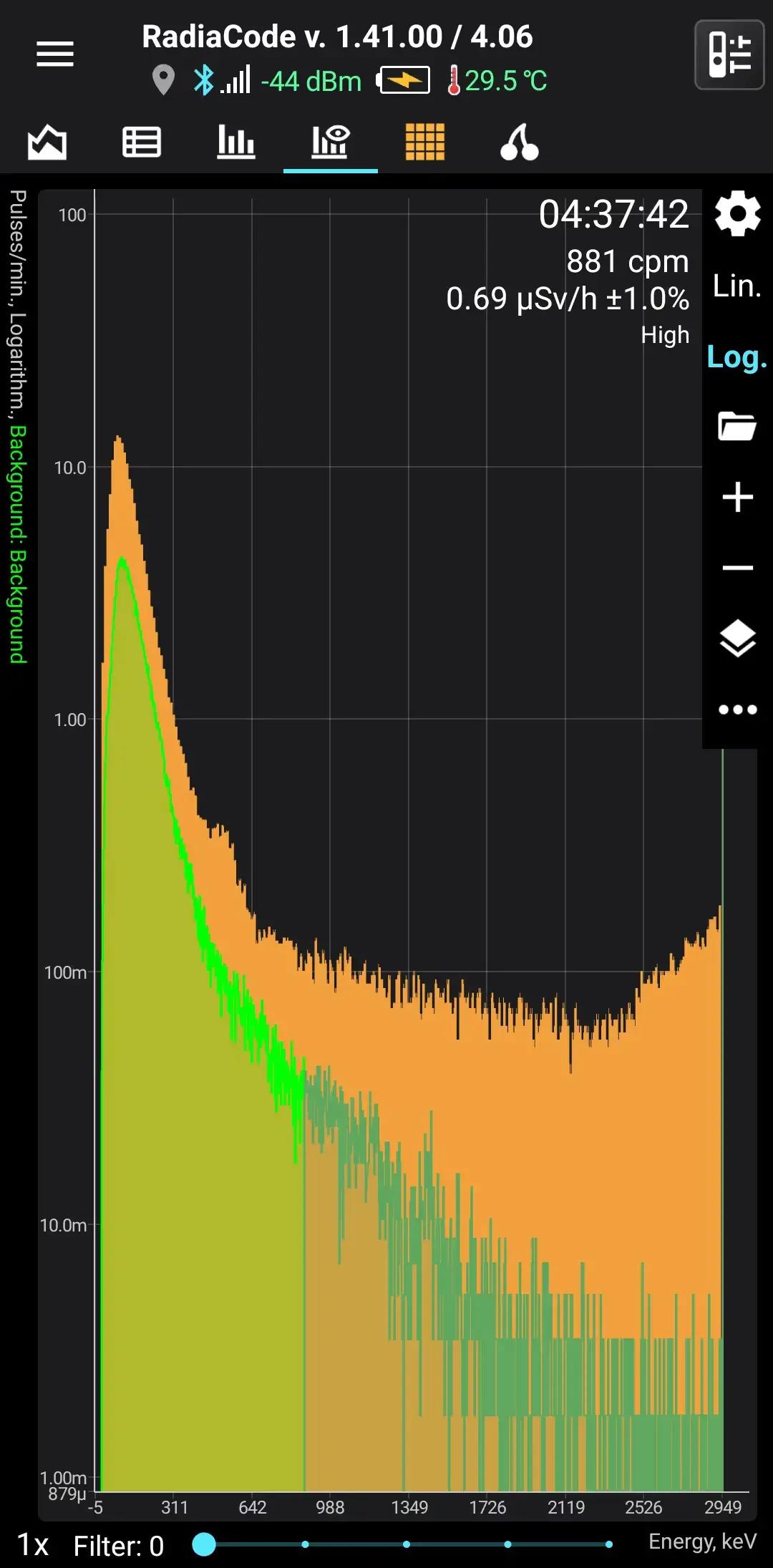
High-energy particles are events that deposit more energy in the detector crystal than the upper limit of the spectrometer (about 3 MeV for Radiacode). The main source is cosmic radiation: muons and other secondary particles created by cosmic rays in the atmosphere. A muon crossing a 1 cm CsI(Tl) crystal deposits about 5–6 MeV, so such events pile up in the last channels of the spectrum instead of forming a peak. High-energy gamma rays and electrons from the same cosmic-ray showers also produce electron–positron pairs in the air, in aircraft structures and in the detector itself; the positrons annihilate and give a weak 511 keV peak, which is often the only line the app identifies in such a spectrum.

This entry is not a radioactive source but a way to understand the right-hand end of the spectrum. Counting these events is a simple cosmic-ray experiment: the rate grows with altitude and is many times higher at airliner cruising altitude than at sea level, and it changes with latitude and solar activity. The high-energy counts also help separate the cosmic component of the background from terrestrial gamma radiation and serve as a quick check that the detector responds to charged particles.

Everywhere: at sea level about one muon per square centimetre per minute passes through the detector, so a small number of high-energy counts is always present in a background spectrum. They become prominent in aircraft, in mountains and at high latitudes: an in-flight spectrum shows no radionuclide lines, only a smooth continuum with a tail rising toward the last channels and a small 511 keV peak.
High-energy particles
Main emission lines: 511 keV (a weak annihilation peak produced by cosmic-ray showers); otherwise, no characteristic lines. During airplane flights, a smooth continuum rising toward the upper edge of the spectrum (around 3 MeV) is often observed. More commonly, however, high-energy events appear in the last channel of the spectrum, which collects all events with energies above 3 MeV.