
Lutetium-176 (Lu-176) is a naturally occurring radioactive isotope of lutetium with an extremely long half-life of approximately 37.6 billion years. It decays by beta-minus emission to stable hafnium-176. Its decay produces characteristic gamma rays, including prominent lines at approximately 88, 202, and 307 keV, making Lu-176 detectable by gamma spectroscopy.

Lu-176 is used in geological research for lutetium–hafnium (Lu–Hf) radiometric dating, which helps scientists determine the ages and formation histories of rocks and minerals. It is also important in radiation detection technology because naturally occurring Lu-176 produces intrinsic background radiation in lutetium-based scintillation crystals, such as LYSO and LSO, commonly used in PET scanners.

Lu-176 occurs naturally in approximately 2.6% of all lutetium. It is present in trace amounts in rare-earth minerals and geological materials containing lutetium. Lu-176 can also be detected in lutetium-based scintillation detectors, where its natural radioactivity produces characteristic gamma peaks even without an external radioactive source.
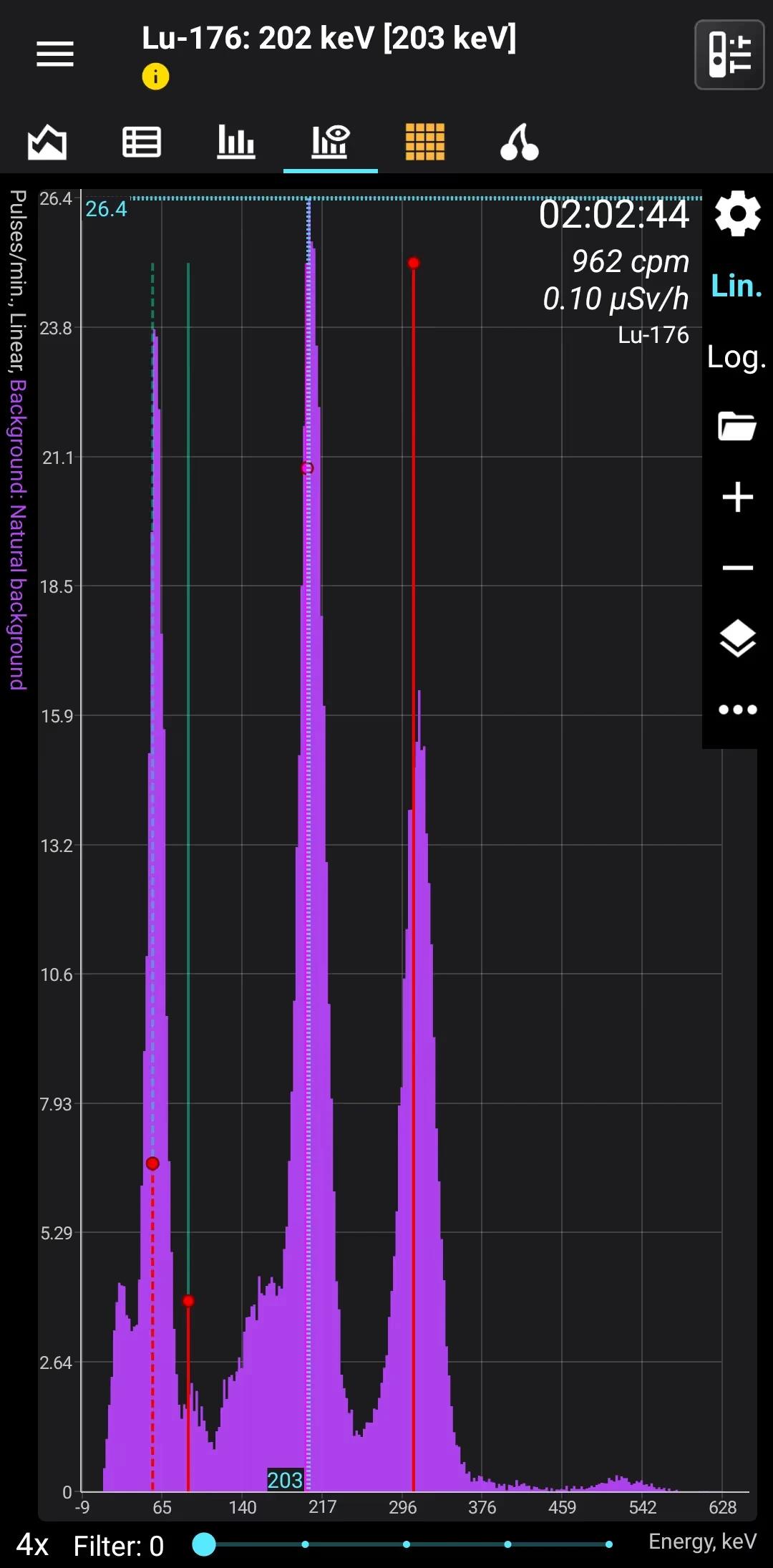
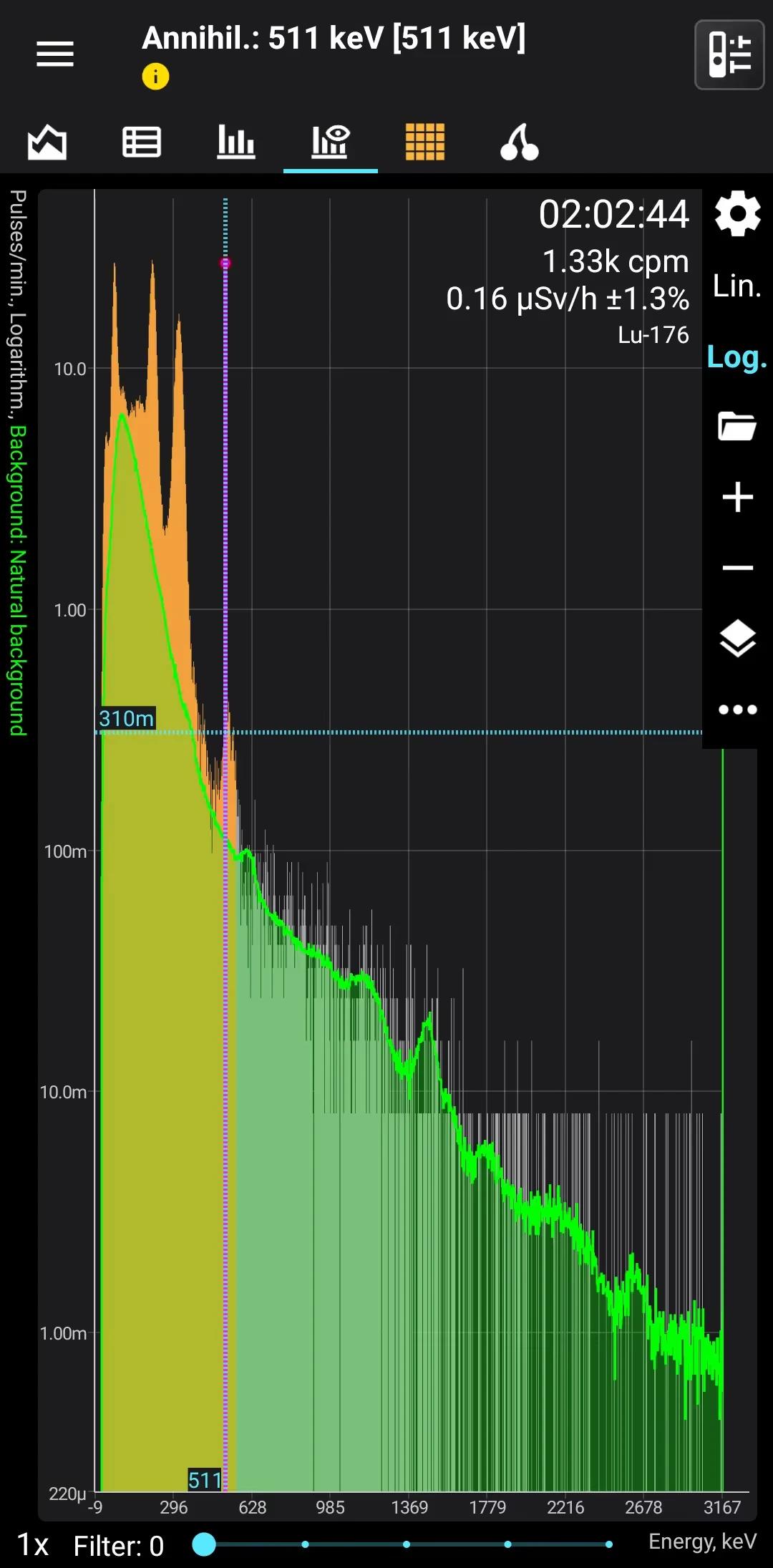
Lu-176
Lutetium-176
Half-life: 38 billion years Main emission lines: 55, 202, 307 keV
Decay mode Beta-
Beta-
| Avg. En., keV | Intensity, % | Decay En., keV |
| 182.3 | 99.61 | (593.2) |
Gamma
| Energy, keV | Intensity, % |
| 306.78 | 93.6 |
| 201.83 | 78 |
| 88.34 | 14.5 |
X-rays
| Energy, keV | Intensity, % |
| 6.960 - 11.268 | 23.1 |
| 55.786 | 16.8 |
| 54.608 | 9.6 |
| 62.981 - 65.133 | 7.04 |
| 62.981 - 63.685 | 5.55 |
| 64.906 - 64.964 | 1.48 |