About The Device
What Radiacode ZERO Can Do
Design, capabilities, and specifications
Radiacode ZERO is a compact radiation detector and dosimeter based on a plastic tissue-equivalent scintillator with a silicon photomultiplier (SiPM) and temperature compensation. Thanks to adaptive data processing, the device provides fast response to changes in the radiation background and high reliability at high doses of ionizing radiation. The device is suitable for field work, inspection of various objects, and continuous monitoring.
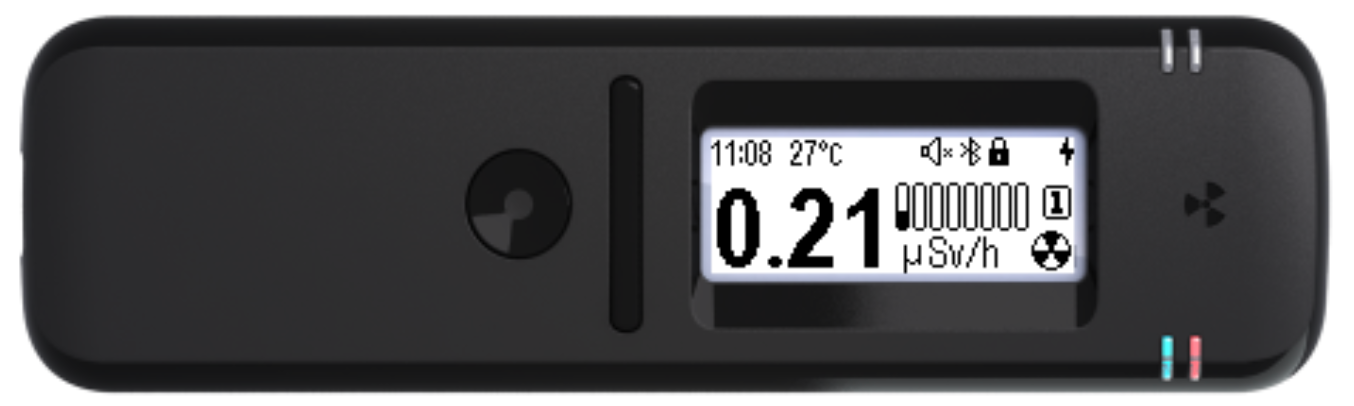
With Radiacode ZERO, the following is always available:
- Area survey and inspection of various objects and materials
- Continuous radiation monitoring
- Automatic data logging to device memory; time-stamped database
- Accumulated dose monitoring
- Radiation source search
- Radiation hazard and environment change alerts
- Standalone operation or paired with a smartphone/computer
- Wireless data transfer; processing in applications for iOS, Android, macOS, and Windows
Device Features:
- Fast response thanks to the plastic scintillator with SiPM and adaptive data processing
- Continuous estimation of dose rate, accumulated dose, and detector count rate on Range 1 — as long as the device is on. Estimation and data accumulation are independent of the display mode
- Wide measurement range thanks to two operating modes and a tissue-equivalent scintillator
- IP64 — dust and splash protection
- Extended battery life (up to 200 hours)
- 6 independent alarm thresholds (2 each for count rate, dose rate, and dose)
- Non-volatile memory for approximately 1000 hours of observations; transfer via USB and Bluetooth; external database storage
- GPS coordinate tagging and display on Google and OSM maps (with a smartphone)
- Apps for PC Windows and macOS, apps for Android and iOS
- Ongoing development; firmware updates
- Energy-efficient graphic display with backlight; adaptive screen orientation
- Audible, visual, and vibration alerts with smartphone mirroring
Aktualisiert: 14. Juli 2026